
If you’re an engineer who’s designing a system that needs bearings, you may already know that ball bearings are versatile. But at Schatz, we don’t take our customers’ knowledge for granted. No matter how much you know already, we recognize that you may need some additional guidance when it comes to choosing the right type of ball bearing for your specific application. And we’re ready to help.
For over 40 years, Schatz Bearing Corp. has partnered with customers to fulfill their unique bearing designs and applications. We do this by providing only precision ball bearings to some of the most demanding industries. Our products include aerospace bearings, defense bearings, semiconductor bearings, medical bearings, space bearings, and bearings for general industrial sectors, among others. All our products are proudly Made in the USA, too.
In this article, we’ll highlight key differences between the primary bearing types, as well as factors to consider when designing bearing systems. We’ll mention our own ball bearing expertise, of course, but we aren’t here to tell you that ours is the only option for your application. Instead, by the time you reach the end of the article, you’ll have a clearer understanding of how to choose the right type of bearing.
First, let’s dive into the three most common types of bearings and some use cases for each type of bearing.
Ball Bearings vs. Needle Bearings vs. Roller Bearings
Ball Bearings
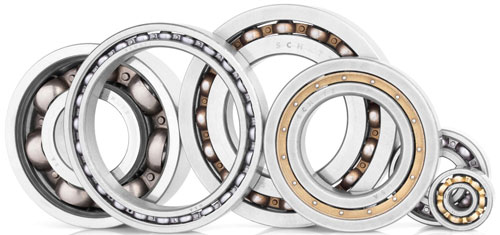
The most popular type of bearing is a ball bearing, which can withstand both radial and thrust loads. As the name suggests, ball bearings have balls as the rolling element. These balls are very precisely made, and they’re matched within millions of an inch to each other.
At Schatz, we specialize in manufacturing very high-precision ball bearings.
Key facts about ball bearings:
- The inner ring’s outer diameter groove serves as a ball raceway, and the inner ring is normally fixed to the rotating shaft.
- The outer ring is mounted into the bearing housing.
- The load is carried from the outer race to the ball and from the ball to the inner race when the load is applied to the ball bearing, which is housed in a race.
- The bearing raceways typically have curvature radii between 51.5% and 53% of the ball diameter. Due to the tight conformance of the balls and raceways, smaller curvature raceways can result in higher rolling friction.
Needle Bearings
A needle roller bearing includes a very thin roller. It’s still a roller bearing, but the rollers are very thin and long (like needles). In fact, these bearings were first manufactured by companies that made needles, which is where the name “needle bearing” comes from. Because the needles within these bearings are so thin, a needle bearing has a very thin cross section.
Key facts about needle bearings:
- This type of bearing is applied in situations where there is a shortage of radial space.
- The needles’ diameter-to-length ratios range from 1-to-2.5 to 1-to-10.
- They can’t be steered precisely because of their small size, and they create a lot of friction.
- They operate at low speeds and oscillating motions. To guide the needles and enhance retention, cages may be employed.
Roller Bearings
Roller bearings have a cylindrical roller in between them, meaning that they have a barrel shaped roller as the rolling element.
Key facts about roller bearings:
- Spherical rollers are strong and have a high load capacity because the barrel profiles of their raceways closely match their barrel profiles.
- Inside the bearing housing, they are mounted in pairs and are oriented in opposing directions.
Next, we’ll look at some questions you need to answer and the best place to begin with your custom bearing request.
Getting started: Key considerations for the right type of bearing
Now that you are familiar with the different types of bearings, there are a few things you should keep in mind as you think about your design.
These considerations include:
- The use case for what you’re designing
- The size of your system
- What loads you have going through the system
- The precision you need
- What your operating environment looks like (e.g., What will the bearing be exposed to? Salt, water, contaminants, etc.)
- Any space, radial and thrust load, and performance requirements
- The turnaround time required for your project
With these considerations in mind, if you need ball bearings, we hope to work with you as you move forward with a bearing request. Through our experience and expertise, we can help customers to solve their application challenges. Schatz has numerous OEM and MS approvals. We make bearings to standards when appropriate, but we can also create custom bearing designs that are tailored to specific applications.
Ready to get started? Contact us here.