
Flexible. Versatile. responsive.

Thin Section
Bearings

What are Thin Section Bearings?

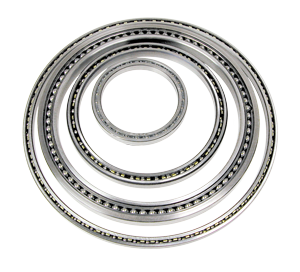
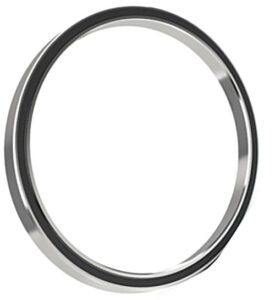
Thin section bearings are used in tight spaces and hard-to-reach places. They appear thinner than standard ball bearings because their cross-section doesn’t become larger as bore diameter increases.

Use these bearings in applications such as:

  • Aerospace and defense
  • Automation and robotics
  • Semiconductor manufacturing equipment
  • Medical equipment
  • Machine tools
  • Rotary and indexing tables
  • Optical equipment
  • Radar, satellite, spacecraft, and general space exploration

Standard and Custom Thin Section Ball Bearings

Schatz makes eight series of thin section bearings with angular (A-type) radial (C-type), or four-point (X-type) contact for bores up to 12″. They’re available in different cross-sectional dimensions and ABEC 1F, 3F, 5F, or 7 tolerances. 
 
Schatz also makes custom thin section bearings. Contact us for more information.

Precision Thin Section Bearing Products

Thin Section Bearing
Smallest cross-section

Our smaller cross-section thin section bearings: between 0.1875" to 0.3125".

STAA Series

  • 0.015” x 45° OD Chamfer
  • 0.1875” Cross-Section
  • 1” to 1.75” Bore

STA Series

  • 0.025” x 45° OD Chamfer
  • 0.250” Cross-Section
  • 2” to 12” Bore

STB Series

  • 0.040” x 45° OD Chamfer
  • 0.3125” Cross-Section
  • 2” to 12” Bore
Mid-sized cross-section

These bearings feature the middle range of cross-section options between 0.375" and 0.750".

STC Series

  • 0.040” x 45° OD Chamfer
  • 0.375” Cross-Section
  • 4” to 12” Bore

STD Series

  • 0.060” x 45° OD Chamfer
  • 0.500” Cross-Section
  • 4” to 12” Bore

STF Series

  • 0.080” x 45° OD Chamfer
  • 0.750” Cross-Section
  • 4” to 12” Bore
Largest cross-section

Our larger cross-section thin section bearings: measurements between 0.437" and 1.000".

STG Series

  • 0.080” x 45° OD Chamfer
  • 1.000” Cross-Section
  • 4” to 12” Bore

STJ Series

  • 0.015” x 45° OD Chamfer
  • 0.437” Cross-Section
  • 4” to 12” Bore

STU Series

  • 0.015” x 45° OD Chamfer
  • 0.500” Cross-Section
  • 4” to 12” Bore

Bearing Specifications

  • ABEC Tolerances: 1F, 3F, 5F, or 7F 
  • Bearing bores up to 12”
  • Cross sections: 3/16”, 1/4”, 5/16”, 3/8”, 1/2”, 5/8”, 3/4”, and 1”
  • Duplexed pairs:
      • back-to-back
      • face-to-face
      • tandem 
  •  Materials:
  • Coatings
    • black oxide
    • TDC
    • zinc-nickel plated
    • cadmium plated
  • Sealed versions incorporate Buna-N molded seals
  • Strict preload control, variety of lubricants and cage designs

Aerospace Thin Section Bearing Applications

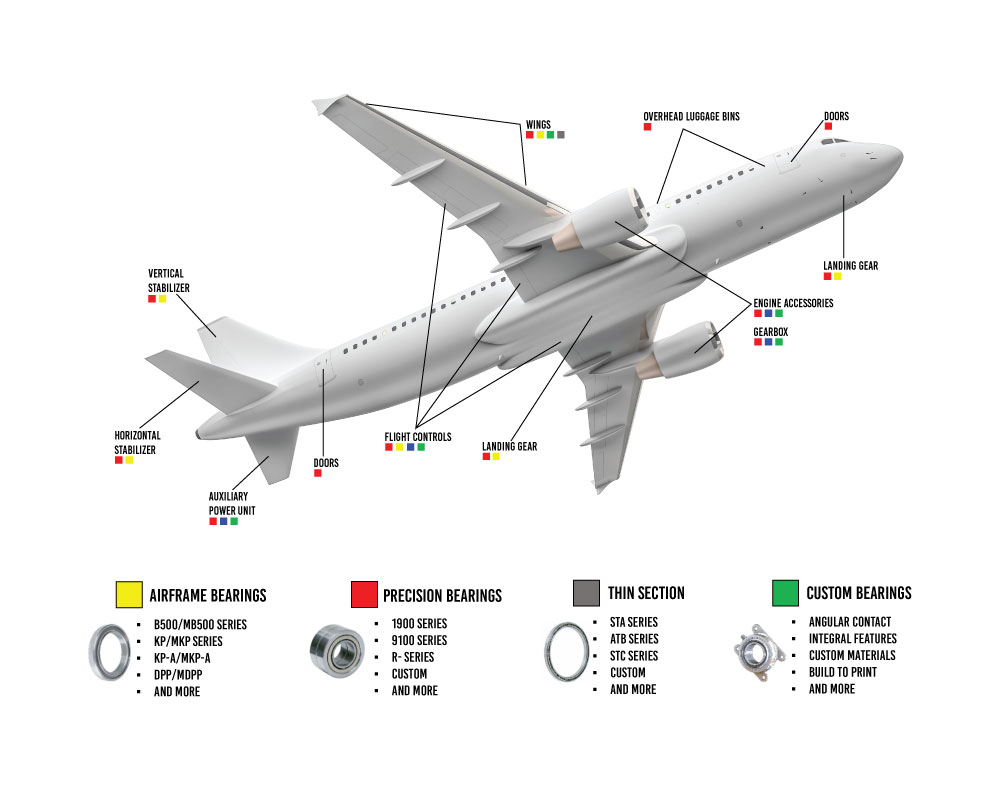
airframe control bearings diagram of aircraft with color coding for types of bearings used in an aircraft including airframe bearings, precision bearings, thin section bearings and custom bearing.

Auxiliary Power Unit (APU)

These bearings are used in APU engines and alternators. Along with HVAC systems, these are two of the major components of auxiliary power units. 

Flight Controls and Wings

They are also used in the ailerons, elevators/stabilators, and rudders that constitute an aircraft’s primary control system. Additionally they are used in the trailing edges of wings.

Engine Accessories and Gearbox

These bearings are also used in aircraft engine accessories and gearboxes to help reduce weight and improve fuel economy.

Frequently Asked Questions

With standard ball bearings, the width and thickness of the bearing increases in proportion to the bearing’s bore size. That’s not the case with thin section bearings because the cross section doesn’t change as the bore size increases. Because of this design, there is little change in the weight of a bearing even as the diameter of the application increases. Also, this supports weight reduction efforts while requiring less space than a standard ball bearing would need.  

  • Their most distinctive characteristic is their smaller cross-section compared to standard bearings with the same bore diameter. 
  • This results in a lighter and more compact overall package.
  • It’s an advantage that’s crucial in space-constrained applications like robotics, medical devices, aircraft components, and gimbal systems.

It’s not the size of the cross-section alone that matters. Rather, it’s about the relationship, or ratio, of the cross-section to the bearing bore. If the cross section doesn’t increase in proportion to the bearing bore in a series of bearings, then it’s a thin section bearing series.

As the table below shows, thin section bearings from Schatz belong to a lettered product series and have a cross-section with a specific dimension. Within each series, the cross section remains the same for all the different bearing bore sizes. 

Series

Cross Section

STA

0.250”

STB

0.3125”

STC

0.375”

STD

0.500”

STF

0.750”

STG

1.000”

STJ

0.437”

STU

0.500”

No. These bearings can also reduce friction and prevent torque loss. Depending on the contact style, thin section bearings have plenty of load-carrying capacity. For example, the thin section four-point contact bearing that is used at the base of a robot’s arm can handle extreme moment loads at the base of the shaft.

These types of bearings are used in applications where space is limited or weight is an important design consideration. These motion control products appear thinner than standard ball bearings because their cross-section does not become larger as bore diameter increases. By helping to reduce space and weight requirements, these bearings can reduce costs for applications ranging from aerospace and defense to automation and robotics – just to name a few.    

  • Typically, it’s because a systems designer has reviewed the application requirements and determined that the critical performance aspects require a thin section bearing.
  • When system compactness, weight reduction, precision, and performance are the critical performance aspects, thin section ball bearings should be considered.
  • These ball bearings, with their reduced cross-section, allow for compact and lightweight system designs. 
  • This can have cascading benefits, like decreased fuel consumption in aircraft or increased payload capacity in satellites.
  • Another benefit is increased design flexibility.
  • Due to their smaller cross-section, system designers have greater freedom for bearing placement.
  • This results in the ability to get the bearing closer to the point of loading, which improves overall system performance.
  • The smaller cross-section results in reduced ball size, and increased ball complement, leading to smoother rotation, lending itself to high precision applications.
  • Their internal geometry is typically optimized to minimize internal losses, resulting in lower friction.
  • The reduced cross-section can allow for a duplex set of angular contact bearings to fit within the same or smaller envelope than a single standard bearing with the same bore diameter.
  • Duplex sets of angular contact bearings or four-point contact designs can support radial, axial, and moment loads simultaneously.
  • This simplifies bearing selection, improving system robustness, and overall system stiffness in all load axes.
  • The most significant disadvantage of these ball bearings is their reduced load capacity versus that of a standard bearing with the same bore diameter.
  • They are also affected by the system around them to a greater extent than standard bearings.
  • Thin section ball bearing rings, being smaller in cross-section, will conform to any imperfections in the shaft and or housing to a much greater than standard bearings.
  • So, thermal variations in the system can result in changes to the bearing performance.
  • Mounting thin section ball bearings can be more complex than mounting standard bearings.
  • This is because they require precise shaft and housing fits.
  • In general, thin section ball bearings are more expensive than standard bearings due to their complex design and manufacturing process.

Yes. Thin section bearings can be radial, angular contact, or four-point contact bearings.

  • Radial thin section ball bearings are used mainly with radial loads, but can also handle minimal axial, reversing, and moment loads.
  • Angular thin section contact bearings are recommended for higher thrust and axial loads; however, these thin section bearings may also be able to handle radial and combined loads.
  • Four-point contact thin section bearings have a raceway that creates four points of contact for handling moment and reversing loads. They are not recommended for radial or combined loads. This design is best suited to support axial (thrust) loads in both (reversing) directions.

Thin section bearings are A-type, C-type, or X-type products. These lettered designations correspond to the contact styles described above.

  • A-type products are angular contact bearings.
  • C-type products are radial contact bearings.
  • X-type bearings are four-point contact bearings.

No. Some are high precision and others are low precision. The ABEC scale defines bearing tolerances and consists of numeric and alphanumeric classes. Because these classes range from largest to smallest tolerances, ABEC 1F thin section bearings have less precision than ABEC 7 thin section bearings. 

Choose a bearing manufacturer who understands the importance of proper heat treating and quenching for thin section bearings. When a ring is heated, the manufacturer must hold it at temperature for a certain amount of time. The ring is then quenched, or rapidly cooled. This can put stress on the part and make the ring out-of-round or out-of-flat.

Technical Articles & Whitepapers

Thin Section Bearings | custom thin section bearings

Custom Thin Section Bearings vs. Standard Products

Custom thin section bearings are designed to meet application-specific requirements in tight spaces and hard-to-reach places. Like standard thin section bearings, these custom bearings maintain a constant cross section as the bore size increases. However, a custom thin section bearing

Read More »
AS9100 certification audit

Schatz Bearing Passes AS9100 Certification Audit

POUGHKEEPSIE, NY (USA) – June 25, 2025 – Schatz Bearing, a leading supplier of aerospace bearings, has passed its most recent AS9100 certification audit with no findings. Schatz designs and manufactures precision bearings for military and civilian customers, including Boeing,

Read More »
videos | Cross section view of 3 thin section bearings | thin section ball bearing

Schatz Releases Four New Videos about Thin Section Bearings

Schatz Bearing Corporation has uploaded four new videos about thin section ball bearings to its YouTube channel. The videos are also available on the U.S. bearing manufacturer’s Thin Section Bearings page, which contains sections about product categories, specifications, applications, frequently

Read More »
Cover page of System Integration of Thin Section Bearings PDF

Whitepaper: Understanding the Performance Impact of Proper System Integration

Bearings come in all sorts of shapes, sizes, and configurations.  As do the systems they are installed in.  Some bearing design families are more affected by the system around them than others.  Arguably one of the most affected by the system around it is the thin section ball bearing design series. 

As the name would imply, thin section ball bearings have a relatively thin cross-section in relationship to their size.  This results in a greater potential for bearing rings to deflect, changing internal geometry, when fit-up into a system.  Understanding the performance impact system integration has on a thin section ball bearing is critical.  It can impact bearing life, stiffness, torque, and multiple other performance aspects. 

The intent of this white paper is to provide a detailed methodology for determining change in internal clearance of thin section ball bearings due to fit up.  It should be noted that this methodology is not limited to just the thin section balls bearing series, but can be used for all ball bearing series, particularly the torque tube ball bearing series.

This white paper describes the mathematical physics of that process and includes an example of an aerospace gimbal system that’s used typically for laser or optical mounts. Request help from Schatz with bearing design and integration

Fill out the information below and the whitepaper will be emailed to you shortly.

Engineering Resources

ABEC Tolerances

ABEC precision tables for bearings of all types. (ABEC tables are a reference of industry standard tolerances for ball bearings)

Technical Information

ABEC precision tables for other bearing types and options for materials, closure, retainers/separators, and lubrication.

Bearing Life Calculations

Capacity and fatigue life of ball bearings plus life adjustment factors.

Disadvantages of Thin Section Bearings

Make sure that this type of bearing is what you really need.

Case Studies

NASA Perseverance Rover on Mars

MARS ROVER CASE STUDY

Schatz Bearing supplied two duplex-sets of thin section bearing designs for use in an articulating arm application for the Perseverance Rover, which landed successfully on Mars on February 18, 2021. Perseverance’s mission was to investigate signs of ancient life and collect samples of rock and regolith (loose rocky material) for a possible return to Earth. 

The 7-foot-long robotic arm had shoulder, elbow, and wrist joints, working much like a human arm. Plus, the turret “hand” held and maneuvered instruments that helped scientists and geologists to get up-close when examining the rocks and soil on the planet. Flexibility was required so that a variety of angles could be achieved to analyze elemental composition microscopically in the field.

These thin section bearings were designed optimal stiffness and stabilized for operation at -280 degrees Fahrenheit (-173˚C). Thin section bearings, such as the ones included on NASA’s Perseverance Rover, provide strict preload control for optimal torque and rigidity, using a wide variety of cage designs and materials to reduce friction, and precision.

gimbal systems

AEROSPACE GIMBAL SYSTEMS CASE STUDY

Aerospace gimbal systems typically use thin section ball bearings in the azimuth and elevation gimbal axes. These applications are torque and stiffness sensitive, as they often house precision optical or laser systems. Changes to internal clearances of these precision aerospace bearings can result in increased torque as well as changes in overall system stiffness. These systems often utilize lightweight housing and shaft materials, such as aluminum, which also present system thermal expansion and contraction concerns as a result of the mismatched coefficient of thermal expansion (CTE) between the bearing steel and the system materials.

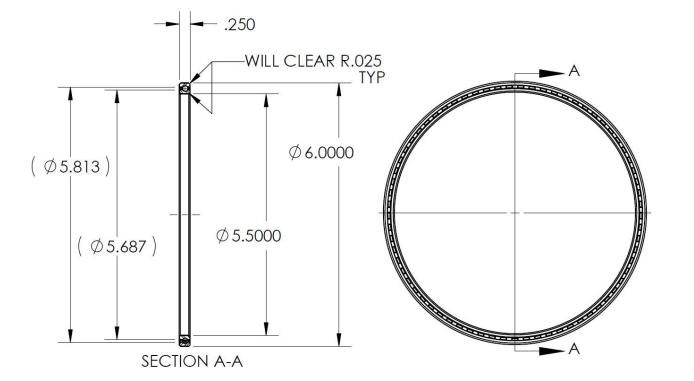
This makes fit up of these bearings, to the systems around them, all the more important. In order to demonstrate this internal clearance change as a function of fit, two different thin section series bearings, with the same bore diameters, where analyzed. These two bearings are SSA055C, shown in figure 8 below, and SSD055C. Both are C type (radial contact) bearings with a 5.5000 inch bore. The A cross section bearing has a .250 inch width and .250 inch radial thickness, while the D cross section bearing has a .500 inch width and .500 inch radial thickness.

Both bearings were analyzed using ABEC 1F tolerances per ABMA Standard 26.2. The housing and shaft were analyzed using aluminum 6061-T4 material properties at a .250 inch radial thickness. All analysis was performed using the methodology detailed in this white paper.

Download Whitepaper Request

Name(Required)
Signup for eNews